36
What can be concluded from paragraph 1?

Children would rather be taught fairy tales than traditional school subjects.

Fairy tales can be regarded as a valuable source of learning.

From a psychological point of view, fairy tales deserve a place in a child’s education.

In the past children appreciated fairy tales more than present-day children do.

The study of fairy tales should be included in general social studies.
37
Which two statements characterise Marina Warner’s new book, according to paragraph 2?
1 It focuses on the fairy tale as a means of promoting the feminist cause.
2 It is less motivated by literary concerns than her two previous books.
3 It is related to her two previous books by the angle she has chosen.
4 It offers information about and an analysis of its subject matter.

1 and 4.

2 and 3.

2 and 4.

3 and 4.
38
How does Warner view fairy tales, according to paragraph 3?

They deal with topics which are of interest to women only.

They have always been a valuable means of expression for women.

They have always served women as an outlet for their imagination.

They present a caricaturised picture of women.
39
Which of the following characterises paragraph 5, with regard to the historical approach
mentioned in paragraph 4?

It compares the historical with the psychoanalytical approach to the fairy tale.

It lists Warner’s arguments against the psychoanalytical approach to the fairy tale.

It reconciles the historical with the psychoanalytical approach to the fairy tale.

It supports Warner’s case for the historical approach to the fairy tale.
40
Which of the following is in line with paragraph 6?

Notwithstanding the abundance of evidence,Warner’s basic assumptions are unsound.

To avoid being accused of bias,Warner does not moralise.

Warner convinces by way of illustration.
41
How could paragraph 8 also begin?

For example, in her otherwise…

However, in her otherwise…

In short, in her otherwise…

Similarly, in her otherwise…
42
What paradox is referred to in paragraph 9?

Warner’s book both lacks relevant data and is burdened with them.

Warner’s book contains both absolutely true and absolutely faulty information.

Warner sets out to inform, but ends up confusing the reader.
 adequate funding
 a great number of bells
 broad-mindedness
 practice
 proper maintenance
 What were the specific demands of the two pupils in the lawsuit against their former
 A review of their exam results and being granted their certificates.
 Compensation for extra educational costs and loss of income.
 Disciplinary measures against their former teachers and a new examination.
 Readmittance to secondary education and extra tuition.
 Which of the following explains the unwillingness of Zurich Municipal (paragraph 2) with
 They are aware that out-of-court settlements may tempt students to choose another
 They fear that an out-of-court settlement may lead to many more.
 They foresee that an out-of-court settlement will not satisfy litigants such as the two
 They have found that going to law is always more profitable than agreeing on out-of-court
 Why are Graham Lane and Doug McAvoy (paragraphs 4 and 5) quoted?
 To demonstrate that the educational world is more concerned with the costs than with the
 To indicate that the interests of the educational authorities and those of teachers conflict.
 To show the indignation and concern in the educational world about the lawsuit brought
 To show the unlikelihood of schools being able to pay compensation to dissatisfied pupils.
 What point does Mr Rabinowicz underline by mentioning Hackney Downs (paragraph 8)?
 If schools fail to meet educational standards, they should be given more financial support.
 It should be possible to hold schools responsible if they fall below the mark.
 Schools should ask for support when they cannot keep up educational standards.
 Young people are entitled to an uninterrupted school career.
 Which of the following would David Blunkett (paragraph 10) agree with?
 Promise rather than punish.
 Seek improvement rather than scapegoats.
 Strive for out-of-court settlements rather than lawsuits.
 Take legal action against schools collectively rather than individually.
 What is the general tone of this article?
 Ironic.
 Matter-of-fact.
 Moralising.
 What can be concluded from paragraphs 11–13 about the House of Lords ruling?
 It is wide open to abuse.
 It may have far-reaching consequences.
 It will inevitably lead to more closures of schools.
 It will stand in the way of educational reform.
 attitude
 conservatism
 fascination
 self-sufficiency
 human interaction
 the biochemistry of the brain
 the dangerous properties of drugs
 the evolutionary process
 an immediate success
 considered a last resort
 extremely expensive
 not considered very effective
 after all
 for that matter
 though
 a drug containing a little serotonin
 a drug containing a lot of serotonin
 an anti-depressant
 an inexpensive medicine
 not proved to be the issue
 shown to be justified
 turned into fact
 abnormal mood
 intelligence
 personal fortune
 physical appearance
 less defeatist
 less sensational
 more bizarre
 more exciting
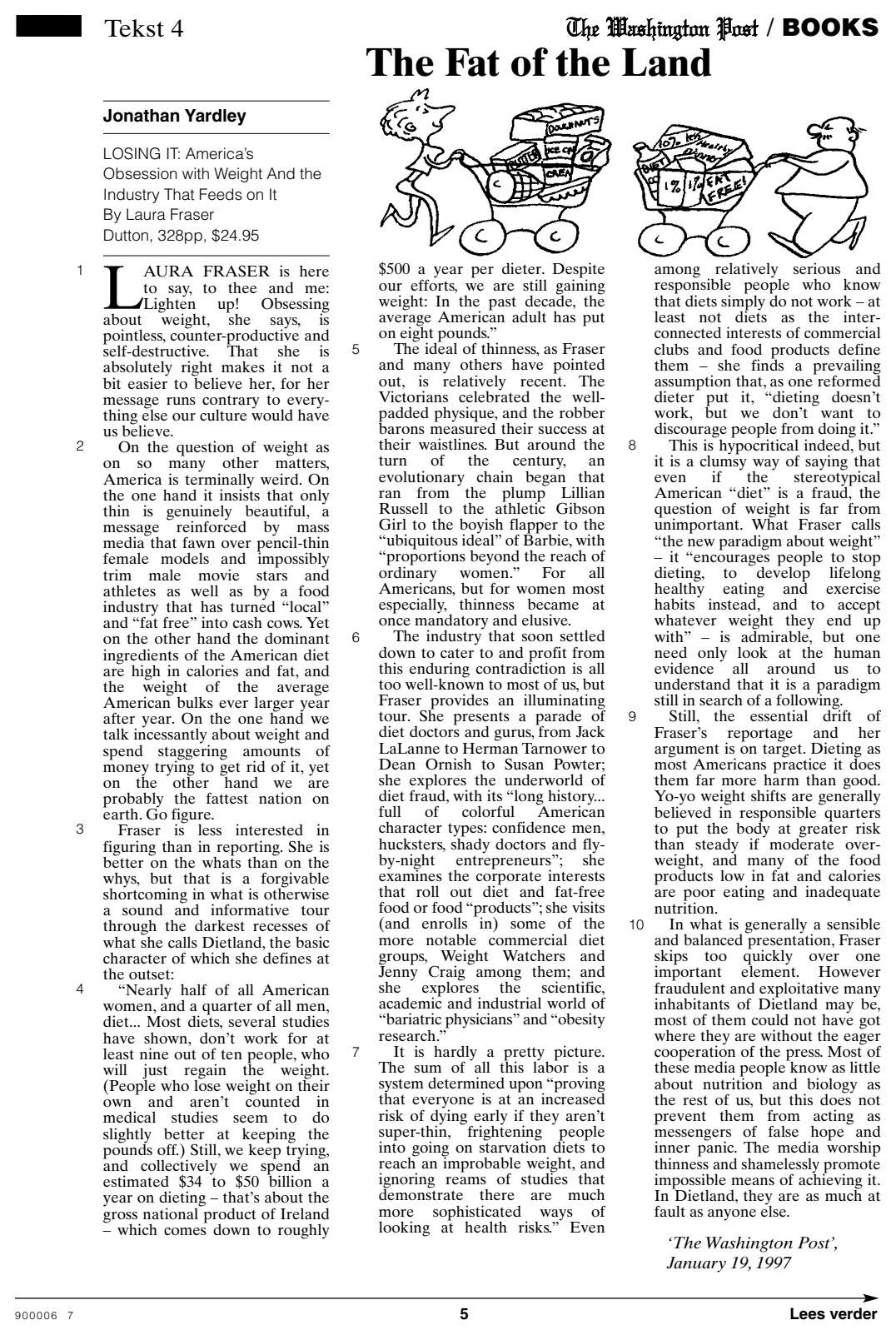
 How does Jonathan Yardley introduce Laura Fraser’s book in paragraph 1?
 By outlining the book and commenting on its main point.
 By recommending the book and criticising it.
 By summarising the book and illustrating its topic.
 How can paragraph 2 be summed up?
 Americans’ preoccupation with weight clashes with their eating habits.
 Being generally overweight,Americans are fascinated by super-slim celebrities.
 In terms of weight Americans can be divided into the excessively slim and the excessively
 Traditional American food is a decisive factor in Americans losing their battle against
 What is meant by ‘figuring’ in the first sentence of paragraph 3?
 calculating
 dieting
 examining causes
 fantasizing
 providing data
 What conclusion does paragraph 4 lead up to?
 All the money Americans spend on dieting seems wasted.
 As in all things,Americans overdo their efforts to lose weight.
 Dieting works for a specific category of physically fit people only.
 It is the female part of the American population that is most obsessed with weight.
 How can paragraph 5 be characterised?
 It demonstrates that the ideal of thinness dates back to 19th century Britain.
 It describes thinness as a tempting and plausible ideal.
 It puts the modern beauty ideal in a historical perspective.
 What is meant by ‘this enduring contradiction’ (first sentence paragraph 6)?
 ideas about beauty can differ so radically from one period to another.
 people are willing to cope with physical discomfort for the sake of physical beauty.
 people feel forced to aspire to a beauty ideal impossible to achieve.
 people set on losing weight merely achieve the opposite.
 Why does the reviewer speak of an ‘illuminating tour’ in paragraph 6?
 demonstrated that the diet industry has appropriated what is in fact a medical matter.
 presented a comprehensive survey of those who have seized on the American
 proved that the problem of overweight is being tackled from every possible angle.
 shown how a preoccupation with food can be found in all walks of American life.
 What conclusion does paragraph 7 lead up to?
 Being overweight is less harmful than has long been assumed.
 Even though dieting has proved ineffective, it is generally not advised against.
 Stimulating people to diet is a way of keeping the problem of overweight in check.
 The ultimate effect of drastic dieting is fatal.
 What point does the reviewer make in paragraph 8?
 Concern with weight is taking precedence over a sensible attitude towards health in
 It will always be easier to gain weight than to lose weight.
 People should stop envying other people’s beauty and value health instead.
 What criticism of the media does the reviewer express in the last paragraph?
 They are accomplices to the glorification of thinness.
 They have unwittingly let themselves become a tool in the hands of the diet industry.
 They produce false information about the effect of dieting, even against better judgment.
 How does President Havel honour New Zealand at the beginning of his address at
 By complimenting New Zealand on its policy of admitting people of all cultures.
 By giving New Zealand credit for not becoming involved in World War Two.
 By praising New Zealand as a country free of ethnic conflict.
 By thanking New Zealand for offering a hiding place to Karl Popper.
 How does Havel describe Karl Popper in paragraph 1?
 attempted to account for man’s behaviour in times of war.
 constructed a theory about the influence of violence and aggression on a multiracial
 pointed out how tribal war and Nazi ideology affect society in a similarly destructive way.
 sought to understand the forces behind man’s inclination towards intolerance.
 How does Havel continue his address in paragraph 2?
 By defining ‘holistic social engineering’ and by supporting Popper’s stand against it.
 By demonstrating that ‘holistic social engineering’ is too idealistic and therefore
 By showing that Popper’s condemnation of ‘holistic social engineering’ helped fight
 Why does Havel bring up the example of his own country (paragraph 3)?
 To show how short-lived the ideals of its former communist regimes were.
 To testify to the vast destruction caused by totalitarianism.
 To warn of the after-effects of communism once it has been overthrown.
 Which sentence could be inserted between ‘abuses’ and ‘This’ in line 57?
 After all, they do not occur only in Communist societies.
 Indeed, more drastic measures were needed.
 In fact they did not get any attention.
 The evil went even further.
 What is the subject of paragraph 4?
 what can put an end to totalitarianism.
 what people can do to rise in society.
 what ways society should be developed.
 Why do some in President Havel’s country prefer to ‘refrain altogether … visions’
 They believe the political situation in their country to be too static for drastic change.
 They feel that their country first has to rid itself completely of the influence of Marxism.
 They have lost faith in the systematic pursuit of change as a result of the recent
 They oppose any change that would go against the concept of holistic social engineering.
 What is paradoxical, according to paragraph 5?
 That both those respectful and those disrespectful of the law should aspire to the same
 That both those with and those without a vision on society should turn against Marxism.
 That the ideas of holistic engineering and of total opposition to change should spring from
 Why does Havel say this?
 He does not want a complete break with his country’s former ideology.
 He does not want to give the impression that his country will not recover from the past.
 He favours planned and constructive change, though he rejects holistic engineering.
 He realises that holistic social engineering still has a foothold in society.
 What phenomenon is referred to by John Thackray as ‘Little Brother’?
 The general condemnation in the US of supposedly dangerous forms of recreation.
 The US business world’s excessive concern for workers’ welfare.
 The US government’s increasingly firm grip on the lives of its citizens.
 US corporations trying to control their employees’ way of life.
 In view of what Ira Glasser has already said, which of the following could be added to
 ‘Companies and employees alike should bear the burden of health care expenses.’
 ‘Smoking and drinking are not the most serious dangers threatening an employee’s
 ‘Therefore employers and employees share the same risks where lifestyle discrimination is
 ‘Unless off-duty conduct affects job performance, it is none of an employer’s business.’
 What ‘ends’ (paragraph 8) are referred to?
 Getting workers to confess risky behaviour.
 Getting workers to feel responsible for their health.
 Getting workers to show consideration for each other’s well-being.
 Why does the writer quote Dr Paul Berger and Paul Terry (paragraph 9)?
 To call into question the ‘assumption’ referred to in paragraph 7.
 To specify the ‘carrots’ referred to in paragraph 7.
 To support the ‘rationale’ referred to in paragraph 7.
 How many example cases does paragraph 10 contain to back up its first sentence
 Two.
 Three.
 Four.
 Which of the following does paragraph 11 illustrate?
 Employees not having the guarantee of privacy when seeking EAP help.
 Many employees’ lack of confidence in the thoroughness of EAPs.
 Some employees’ tragic ignorance of the kind of support an EAP may provide.
 The instinctive mistrust of employees with regard to counselling by means of computer
 Why does the writer mention the American Eagle ATR turboprop crash
 the damage that misdirected EAP counselling can cause.
 the exploitation of EAPs for the benefit of a company’s aims.
 the extent to which companies may put their trust in EAPs.
 the hazards of companies disregarding their employees’ expert judgment.
 the way in which a small number of people can obstruct the work of many.
 What is The Economist’s main concern in its article on ‘The Third Battle of Newbury’?
 In their handling of protests the police have come close to abuse of power.
 Obstructive protesters may be putting freedom of expression under threat.
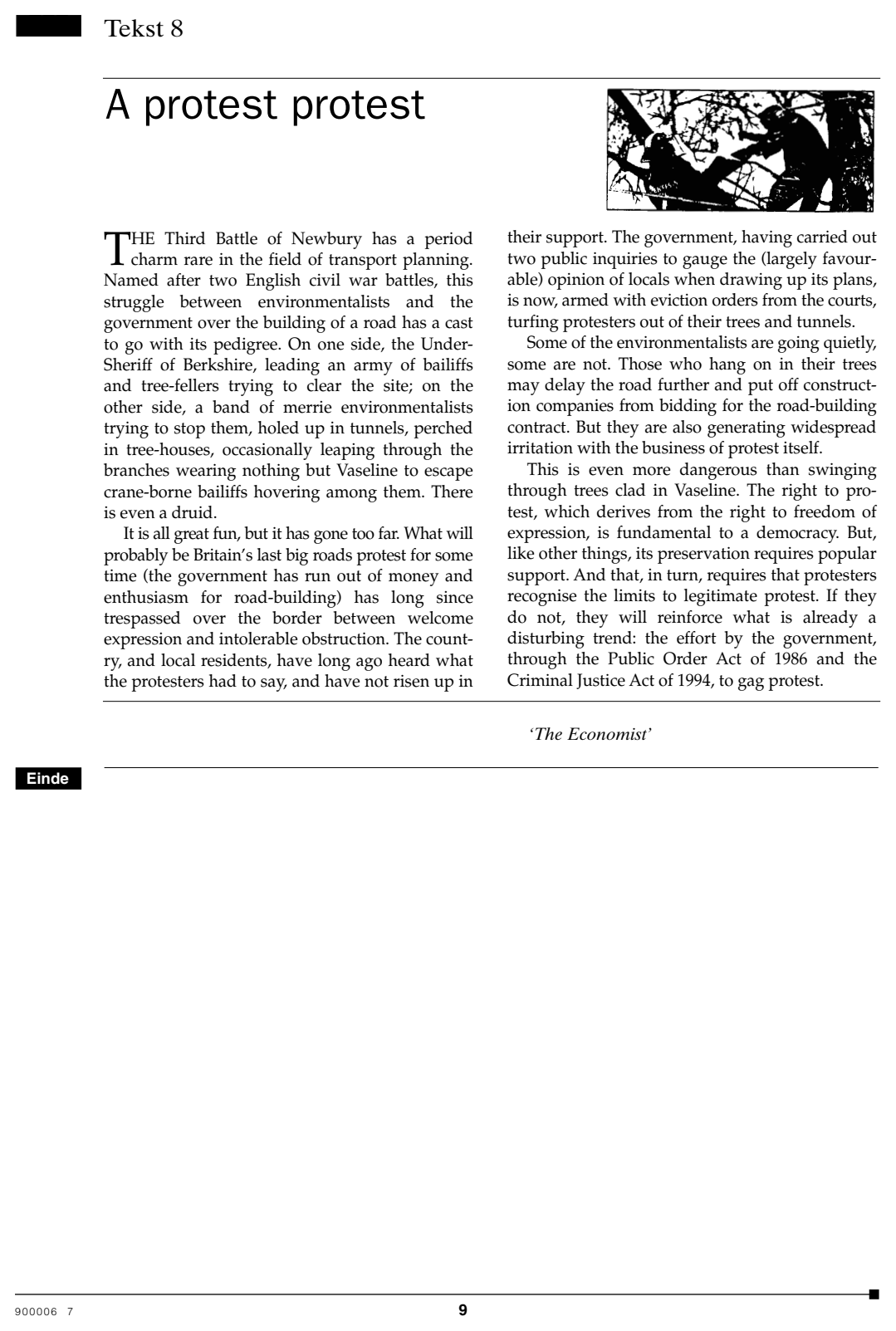
 Protesters may no longer be appreciated for the way they seek publicity.